 |
|
|||||||
|
|


 |
|||||||||
|
|||||||||
 |
 |
||||||||
 |
|||||||||
|


|
|
|||||||
 |
|||||||||

 |
 |
 |
MAKING OF... (page 6) |
||||||||||||||||
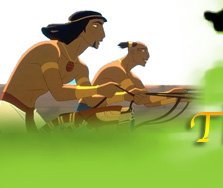
MODERN-DAY WONDERS You cannot bring the Exodus story to the screen without depicting miracles, and you cannot depict miracles without special effects. "The Prince of Egypt" breaks new ground in the effects arena, with the introduction of pioneering technology, as well as new approaches to traditional methods. The look of the film would not have been possible without these technological breakthroughs, and, conversely, the technological breakthroughs depended on traditional methods to make them work for the film. The most significant breakthrough was the revolutionary exposure tool, which was developed by DreamWorks in conjunction with Silicon Graphics, Inc. (SGI). The exposure tool facilitates the seamless integration of 2-D and 3-D elements in a scene. For the layout artists, supervised by Lorenzo E. Martinez, the exposure tool was the key that opened the door to a new era in animation camera work. Scene planning supervisor David Morehead expounds, "The exposure tool actually allows you to set your stage with any combination of 3-D elements and 2-D paintings and drawings, and then lets you choreograph them as you move through the scene with your camera." Co-visual effects supervisor Don Paul adds, "It opened up the scope of the picture, allowing us to do the kind of camera work that's never been seen before in an animated film." Two of the most striking applications of the exposure tool come early in the film. The first is at the end of the prologue. As we pull away from the Queen's tranquil water garden, the camera steadily rises up through a high scaffolding on which Hebrew slaves labor under the desert sun, finally revealing the vast panorama of the Egyptian Empire. The exposure tool allowed layout artist Harald Kraut to compose the first animated crane shot that encompasses hundreds of 2-D and 3-D elements simultaneously. We then smash cut to another example of the seamless merging of 2-D and 3-D animation and camera work made possible by the exposure tool: the breakneck chariot race through the city between the young Moses and Rameses. The two princes are traditional hand-drawn animation, as are their horses, while the chariots are 3-D props. As the cameras follow the rushing chariots, the walls of the city-another traditionally hand-painted element-seem to fly by. Using rapid cutting and constantly shifting angles, the cameras continue to keep pace with Moses and Rameses as they careen through the streets and alleys onto a scaffolding, which collapses. The young men narrowly miss being crushed by a huge stone nose that breaks off a statue, only to be swept away by a river of sand when the embankment they are on gives way. This extremely ambitious sequence required a combination of complex camera work and the marriage of 3-D computer-generated elements (the scaffoldings, the chariots, the sand and the nose) with traditional 2-D elements (the princes, their horses, some clouds of dust and the painted backgrounds). "The exposure tool let us apply cinematic techniques-like constantly repositioning the camera and chasing the action-which would not have been possible before," co-visual effects supervisor Dan Philips states. A more subtle application of the exposure tool is seen in the sequence known as the Hieroglyphic Nightmare, in which two-dimensional hieroglyphs move along the walls, segue onto columns and then back onto another wall. In conceiving the scene, Simon Wells says he imagined, "if you're two-dimensional, the only way to hide from other two-dimensional beings is to somehow escape into a third dimension where they can't see you." Rabins reveals, "The hardest part was to make the characters appear as if they had been carved into the wall, and to carry the cracks and textures of the walls and columns onto the images moving over them. Dave Morehead did a great job accomplishing this effect using various software and the exposure tool." The hieroglyphs seen in "The Prince of Egypt" were created in the style of genuine hieroglyphs seen in Egypt. They were designed by illustrator and graphic designer Hani D. El- Masri, who also crafted the authentic tools and props seen in the film. In a live-action film, the goal is normally to make the visual effects seem photorealistic, but in animation, the effects must blend with the hand-drawn appearance of animation and the style of the painted backgrounds. To help achieve this, the filmmakers began by un- departmentalizing the staff. "We mixed people up, sitting a traditional artist next to a CG artist, so they could design shots together," Paul says. "It really opened up communication, creating a new visual vocabulary, which helped to integrate everything and raise the quality to a new level." Also raising the quality was the use of fine artists to create the 885 hand-painted backgrounds which set the backdrop for the story. Supervised by Paul Lasaine and Ron Lukas, the artists also did a myriad of paintings that were texture mapped onto the computer generated elements to carry the same painterly style throughout the film. Philips says, "We created pieces of artwork- whether it be with a pencil, a brush, a keyboard or a mouse-and brought them together visually so they exist in the same world." It is misleading to think of special effects in animation in the same vein as live action. Every frame of an animated film has to be created, so, in that context, effects encompass even subtle things like shadows, light, reflections and the glint in a character's eye. The effects work in "The Prince of Egypt" primarily focused on three "miracle" sequences: the Burning Bush; the Plagues, culminating with the Angel of Death; and the climactic parting of the Red Sea. Director Brenda Chapman comments, "Taking a cue from the art direction, we drove everything that represented God toward the organic. The fire of the Burning Bush, for example, is a sort of slowed-down flame, and the effect it produces on the surrounding rocks is like light reflecting off water. If you watch, you will also see that the bush grows and flowers throughout the scene to demonstrate that the bush burns but is not consumed." The production pushed the edge of the effects envelope by enlisting the talents of live-action special effects artists, including Henry LaBounta, an Oscarr nominee for his work on "Twister," and Doug Ikeler, who worked on such films as "Babe," which won the Oscarr for visual effects. Ikeler, the sequence lead on the plagues, had challenges as varied as the plagues themselves. "The first plague, blood, not only had to look like blood floating in the water, it had to act driven," he illustrates. "For the plague of hail, the falling hail fire exploded into a molten lava-like substance when it hit the ground, and left a vaporous smoke trail, which gave it an eerie beauty." For the plague of pestilence, Ikeler had to create motion cycles for the bugs that are seen crawling out of a loaf of bread, which in turn disintegrates as it is eaten away. The bugs also had to interact with items on the surface without running into them. A very different kind of infestation, the plague of locusts, required him to manifest 7,000,000 swarming locusts. Jamie Lloyd served as the sequence lead for the Angel of Death, as well as the Burning Bush. Seen in the final plague-the death of the first- born-the Angel of Death is described by Don Paul as "a breath that goes through and takes life. It also had to be very organic-a thinking image that could pause at a doorway and enter or move away." The plagues of blood, hail fire and locusts and the Angel of Death were achieved using 3-D particle systems, which are like little dots in space. Using the computer, the animator can apply forces such as gravity or wind to move them around. Once each particle's position is set in space, it can be rendered to attain the desired look, whether fire or insects. The most formidable task the effects artists faced was the parting of the Red Sea. Henry LaBounta led a team of no less than 10 digital artists, who collaborated with 2-D artist Jeff Howard and 16 traditional animators and two programmers to accomplish the powerful sequence. In the end, it took more than 318,000 hours of rendering time to complete this seven minutes of screen time. Leading up to the parting of the Red Sea is the Pillar of Fire, which LaBounta says "was a familiar challenge for me, because I had just finished supervising the tornado work on `Twister.' My initial instinct was to create a tornado of fire, but I soon realized that the visual challenge here was to avoid making it photorealistic." The parting of the Red Sea began with visual development artwork, from which the filmmakers were able to determine the overall look they wanted. The artwork, for example, led to the decision to have the water pull away in a circular pattern, rather than the more familiar separation split. The filmmakers wanted the Red Sea to have incredible scale but still look like the visual development artwork on which the design was based. LaBounta says, "We developed digital techniques which gave us the level of detail necessary to convey a huge scale, but the style of hand-drawn animation is difficult to simulate." Using tiny variations of drawn splashes, LaBounta and his team were able to give the large simulations the look of hand-drawn artwork. They also applied the simple shapes that a brush stroke creates as the base element of the water texture. In many cases, the traditional artwork was blended into the digital animation, allowing the latter to reflect the same lighting and atmosphere as the artwork. Water, from the Nile River to the Red Sea, is a central element of the film. "We used every technique imaginable to produce the water effects in `The Prince of Egypt,'" Philips says. "They ran the gamut from traditional animation to 3-D effects to 2-D CG, which is a digital approach using traditional paintings. We are very proud of the result, which is like a living painting."
|
||||||||||||||||


 |
 |
 |
 |
|||||
 |
 |
||||
|
|||||





 |
|||||
|
 Buy DVD  Buy Posters |
|
|||
|
|||||


