| 
|
The Making Of (Part IV)
|
 |
|
A SMALL WORLD
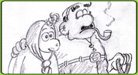 Despite the influence of computer animation, "Wallace & Gromit: The Curse of the Were Rabbit" does not compromise on the classic, old-world style for which Aardman's most famous duo is known. In fact, while technology has revolutionized much of the animation industry, the painstaking techniques of stop-motion animation--though refined over the years--have remained virtually unchanged since the genre's inception.
In some ways, clay animation actually has more in common with live-action filmmaking than other forms of animation, because the characters and sets are all physical, not drawn or computer-generated. Aardman has often referred to their particular style of filmmaking as "live action in miniature," miniature being the operative word.
There are no location shots in clay animation because, short of traveling to Lilliput, it would be impossible to find locations to fit characters who range from 10- to 12-inches tall. Production designer Phil Lewis was charged with designing 30 individual sets down to the very smallest detail. Having served as the art director on the Wallace & Gromit shorts, Lewis was all-too-familiar with the design of the pair's home at 62 West Wallaby Street. One major change to the décor was the wall of portraits of Anti-Pesto's clients, fitted with flashing eyes that sound the alarm if rabbits are on the prowl for vegetables.
In contrast to Wallace & Gromit's modest residence, the Tottington Hall sets were designed to be elegant and imposing. The stately home of Lady Tottington--complete with its breathtaking rooftop conservatory and lavish gardens--was mainly inspired by the National Trust's landmark Montacute House and took eight weeks to build.
Over 100 varieties of foliage were researched and recreated to add an authentic look to the countryside gardens, woodlands and greenhouses. The greenhouses themselves feature tiny panes of real glass. Filling the gardens, more than 700 little plaster vegetables--mostly melons, pumpkins and carrots--were molded, painted and planted in the ground in anticipation of the "giant" vegetable competition.
All of the wallpaper seen in Tottington Hall and other sets was entirely hand painted. The gardening tools, as well as those seen in Wallace's workshop are working tools, crafted in miniature.
 Tremendous attention to detail was paid in the creation of Wallace & Gromit's Anti-Pesto-mobile, which is a miniaturized Austin 35. Various scale models of the van were created, each probably costing more than the original Austin. Virtually everything about the car worked, from the headlights, to the turn signals, to the windshield wipers. The windows, doors, hood and trunk all opened and closed and the doors could even lock. The car builders even made sure that when the tires drove over the ground, they would have the proper compression.
Given the meticulously slow pace of the production, filming was always happening on multiple sets simultaneously. Directors Nick Park and Steve Box split the scenes each would cover, often walking five miles over the course of the day to check on the various sets in operation.
There were also two directors of photography, Dave Alex Riddett and Tristan Oliver, who were responsible for controlling camera movements and maintaining correct light and shadows throughout the filming of a scene, which could take days, weeks or even months. Taking a little of the pressure off of the cinematographers, camera moves are now controlled by computer, so the animators could block for the camera and know exactly where it was going to be at any given point. Nevertheless, if a mistake was made, it was virtually impossible to go back and fix it. Oliver explains, "In live action, you have the luxury of another take. With this kind of animation, you can't do that. If you make a mistake and have to retake, you'll have an animator cursing you because something you've done has cost him six days of work."
In lighting the scenes, Riddett and Oliver were able to apply a lower level of light because stop-motion camera shutter speeds are slower than those in live action. Rather than film lights, they used theatrical lighting, which is smaller and more controllable. Carefully positioned mirrors were also used to angle light down into the small sets, and colored gels helped to create the proper tone.
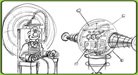 For longtime fans of the Wallace & Gromit shorts, there is nothing that sets the tone better than the strains of a Yorkshire brass band playing the instantly recognizable themes composed by Julian Nott. Hans Zimmer, who collaborated with Nott as a music producer, notes, "It was easy to find the tone, because Julian had done all the groundwork with the shorts. One of the things I thought we should try to do was to amplify the feeling of the shorts through the music. We may have a bigger band than Julian used before, but it's still the familiar sound of a Yorkshire brass band."
Julian Nott acknowledges, "It was a very different process for me dealing with a 90-piece orchestra. It's also almost wall-to-wall music for about 85 minutes, and if you don't do it right, I know it can get on your nerves. But I learned certain techniques from Hans, and Hans is obviously an expert on getting it right."
Park offers, "Julian and I met at college and he has always been the Wallace & Gromit composer. He wrote fantastic music for all the shorts, so he was an absolute must to compose the score for our first Wallace & Gromit feature. Hans Zimmer came over as a consultant and it was great to have someone of his caliber here, but the score very much reflects Julian's take on everything."
"The most important thing to capture was the charm of Wallace & Gromit," Nott says. "They are very optimistic and there is not a drop of cynicism in them, which is pretty rare for a British product. But mostly it's the charm; you can't help loving them."
Park agrees. "We didn't want the music to be too big; it still had to be the Northern brass band. We didn't want to get away from what is Wallace & Gromit. We had the production values of a feature film, and yet we maintained the handmade quality, which I think is quite important. We had a giant production behind us, but it was our duty to keep it looking as if we're still just a couple of blokes working out of a shed in Bristol. There is a feeling of 'smallness' that was important to keep. That," he concludes, "is where the charm is."
Untitled Document
| SUPPORT
US: BUY FROM OUR PARTNERS |
|
|
|
Untitled Document
|