 |
|
|||||||
|
|


 |
|||||||||
|
|||||||||
 |
 |
||||||||
 |
|||||||||
|


|
|
|||||||
 |
|||||||||

 |
 |
 |
MAKING OF...(page 2) |
||||||||||||||||
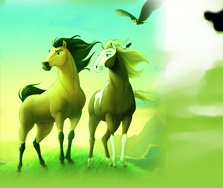
HORSE SENSE The first and perhaps most daunting challenge in making the film came with the title: "Spirit: Stallion of the Cimarron"?a stallion being, by definition, a horse. "Horses are among the most beloved and beautiful creatures on the planet," Katzenberg says, "and I think there is a connection that we as human beings have had with horses, going back thousands of years. For all of those reasons, I loved the idea of an animated movie about horses, but I know there is no animal more difficult to animate." There are several elements that have kept horses primarily off the drawing boards of animators. They have a long, inflexible spine, a defined musculature seen in their every movement, and a wide range of gaits. Their faces pose another kind of challenge, characterized by an elongated muzzle, with the eyes set high and wide, and the mouth set low. Understanding the problems, Katzenberg knew that when he told the animation team "horses," he was throwing down the gauntlet. But he also knew who would be the first to pick it up. "If you were to name the greatest animators working today, James Baxter would be one of them," Katzenberg states. "I went to him and said, ?James, I want to give you a challenge.? Right from the start, he was so enthusiastic about the idea. He led the charge and rallied the rest of the animators, and together they set an extraordinary benchmark for what could be achieved." The senior supervising animator for the character of Spirit, Baxter admits that his initial enthusiasm was somewhat tempered by the reality of the task ahead. "It was the hardest thing I?ve ever undertaken on a picture. I literally spent the first few weeks with my door shut, telling everyone, ?Go away. I?ve got to concentrate.? It was quite daunting because when I first started to draw horses, I suddenly realized how little I knew." What the animators didn?t know, they were about to learn. The entire animation team began an intensive crash course in equine anatomy, movement, locomotion and behavior. With the Los Angeles Equestrian Center conveniently located within a mile of the DreamWorks animation campus, the animators spent hours upon hours studying and sketching real horses. Much of the time was spent observing a magnificent buckskin-colored mustang stallion, which served as the real-life model for Spirit. The animators also benefited enormously from the expertise of two of the horse world?s most respected authorities, Dr. Deb Bennett and Dr. Stuart Sumida, who served as the film?s horse consultants. The consultants engaged the animators in a multi-pronged training program, teaching them about horses from the inside out. The lectures might have left the animators wondering if what had appeared challenging was closer to impossible. Aside from the fact that horses have that long, rigid spine, other parts of their anatomy are almost always moving, from the long neck that bends and swings, to the tail that flicks and swishes, to the ears that pivot to capture sound, to the lips that serve as their "hands." Putting it all in motion, the animation team was educated about the varying gaits of a horse, beginning with a walk and accelerating to a trot, a canter, and a full gallop. More than just the speed, they had to learn the individual components of each gait, not to mention the emotions behind them. For example, the frolicking gallop of a horse at play is entirely different from a gallop instigated by fear. To depict motion, animators often use a technique called "squash and stretch." "In cartoon terms, it is when you deform an object, squashing it down or stretching it out, depending on how it?s moving," Baxter explains. "The more ?cartoony? the project, the more extreme you can get with it, but the more realistic the project, the more subtle it has to be. We did use squash and stretch on the horses, but it is very contained and in very specific parts of their bodies?it?s in the shoulders, it?s in the fetlocks? It is there, but it?s subtle and hidden." To Drs. Bennett and Sumida, it was especially important to pass on to the animators a healthy respect for the intelligence and complex emotional lives of horses. "Horses are actually really smart and very curious, and they have the range of emotions and feelings that you would expect of any intelligent animal," Sumida says. "Horses are also extremely honest," Bennett adds. "What I mean by that is they do have ways of transmitting what is going on inside and how they are about to react, so it was important that the animators be able to ?read? a horse and then put that information on the screen." That ability was key to James Baxter and the team working on the character of Spirit, who is in virtually every scene in the movie and whose emotions run the gamut from the joy of freedom, to the desperation of capture, to his defiance of being broken. Baxter notes that Spirit?s name was his first inspiration. "We set out to create a horse that felt indomitable. He?s extremely proud and very brave, and his desire for freedom overcomes everything. At the heart of the character is a spirit that cannot be broken." Though the supporting equine cast had considerably less screen time, conveying their thoughts and emotions was equally challenging for William Salazar, the supervising animator for the character of Rain, the paint mare who becomes Spirit?s love interest, and Sylvain DeBoissy, the supervising animator for Spirit?s mother and the rest of the Cimarron herd. Every thought and feeling held by the horses had to be communicated entirely through body language and facial expressions. Kristof Serrand, the film?s animation supervisor, comments, "When you have an actor?s voice to work with, you have a starting point for your character. But when your character doesn?t talk, you have to do everything in pantomime, which is a huge challenge, and even more so when you can?t at least use hands for expression. Horses don?t have hands, they have hooves, so even our gestures were limited." For any character, but especially for one who doesn?t speak, an animator also relies heavily on eyes and eyebrows to express emotions. However, horses don?t have what we would call eyebrows and their eyes are located to the sides of their head, so you don?t typically look into both eyes at the same time. Taking a little bit of equine creative license, the animators moved the horses? eyes slightly forward and gave them more white around the irises, as well as defined eyebrows. Nevertheless, when the consultants finally got to see the animated horses on the screen, they could not have been more pleased. "They got it right," Bennett confirms. The same attention to detail was paid to things heard but not seen. The horse sounds heard in "Spirit: Stallion of the Cimarron" are authentic. Supervising editor Nick Fletcher and sound designer and supervising sound editor Tim Chau visited stables to record a wide variety of neighs, whinnies and other horse sounds, which would allow them to give the lead horses distinct voices. They then looked to director Lorna Cook to match those sounds to the right character in the right context. "Lorna Cook has had so much experience with horses, it was almost like she had an innate understanding of what they were saying," Fletcher says. "She would tell us which sounds to use where, and we in turn gave that information to the animators, so they could animate to those sounds." Cook responds, "We knew we had to replace conventional dialogue with its equine counterpart, so it was important to find the appropriate tone to articulate what the horses were saying without words as we understand them."
|
||||||||||||||||


 |
 |
 |
 |
|||||
 |
 |
||||
|
|||||





 |
|||||
|
 Buy DVD  Buy Posters |
|
|||
|
|||||


