 |
|
|||||||
|
|


 |
|||||||||
|
|||||||||
 |
 |
||||||||
 |
|||||||||
|


|
|
|||||||
 |
|||||||||

 |
 |
 |
MAKING OF... |
||||||||||||||||
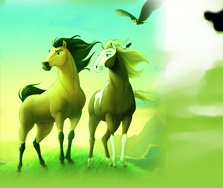
BREAKING TRADITION DreamWorks Pictures? newest animated feature, "Spirit: Stallion of the Cimarron," goes to show that what is regarded these days as traditional animation is anything but traditional. The advent of the computer in animation has revolutionized the genre, perhaps most notably with the inauguration of entirely computer animated films, like last year?s Academy Award¨-winning "Shrek." However, the computer has also had an ever-increasing impact on 2D?or what is known as traditional?animation. The proof of this is the surprising fact that, for all its painterly qualities, "Spirit: Stallion of the Cimarron" is DreamWorks? most technologically complex animated film of any kind to date. Nevertheless, while the mouse may have become one of the animators? most important tools, producer Jeffrey Katzenberg is quick to point out that no computer can, or should, ever replace the hands-on artistry that sets traditional animation apart. "The thing that is unique to traditional animation is what happens when an artist, an animator, gives life to a character with his or her own hand," Katzenberg offers. "There is nothing else like it in the world. It?s like the difference between getting an email and a handwritten note; it?s personal?it?s intimate. It?s a direct creation of life with a pencil on a piece of paper. Computers can?t do that?not yet." That being said, Katzenberg adds, "The computer is not the nemesis of traditional animation. What I wanted to do with this film was to take hand-drawn animation and marry it together with state-of-the-art technology to create a film that is the best of both worlds. I?ve been looking for a word that describes it. I consider it to be almost a reinvention of traditional animation, so I?ve been calling it ?tradigital.?" "Spirit: Stallion of the Cimarron" is by no means the first traditionally animated film to incorporate 3D, or computer animated, elements. However, the film represents such a wholesale marriage of these two techniques, that some of the production team have referred to it as a hybrid form of animation. Specifically with regard to character animation in a 2D film, computer rendering had primarily been relegated to background "extras." Here, even the lead characters, including Spirit, are sometimes computer animated depending on the needs of the shot. In fact, there are perfectly seamless transitions from computer to traditional animation involving a single character in a single scene that no one but a seasoned animator would be able to discern, and even they would be hard-pressed. The primary example of this comes early in the film, as we see the adult Spirit running with his herd. As they run, we are watching 3D animation of not only the herd, but also of Spirit himself. However, as Spirit separates from his herd and comes up to the crest of the hill, the camera zooms in to circle around him, and we witness, but don?t see, an absolutely imperceptible 2D takeover of the shot. Then, as the camera moves back, there is another takeover, this time 3D, that is equally seamless. That is only one of many examples of the synergistic artistry of computer and traditional animation in "Spirit: Stallion of the Cimarron." Whether 2D or 3D, horses are notoriously difficult to draw and even more so to animate, which speaks to why "Spirit: Stallion of the Cimarron" is the first animated film to feature a horse as its central character. Adding to the challenge, the horses in the film do not talk. "We wanted to break all the rules, beginning with the fact that the movie is told through the eyes of a horse, and the horse doesn?t talk. No animals in the movie talk," Katzenberg points out. The decision to have the horses not speak was made early in the production. Director Kelly Asbury recalls, "We realized that the minute you have a horse speak, it?s a comedy. You just can?t take a talking horse seriously; it was comical no matter what we did. So, the choice was to make the animals more natural and allow them to act through the animation." Despite there being no spoken dialogue between the animals in the movie, and not much more on the part of the few human characters, there was still a screenplay, written by John Fusco. Producer Mireille Soria remarks, "John was ideal for this project because not only has he written movies about the Old West, but he also owns mustangs and is an honorary member of the Oglala-Lakota Tribe." Soria goes on to explain that, with his background and knowledge of the subject at hand, Fusco took an unusual approach. "He did an outline first, which is perfectly normal, but he then wrote a novella instead of a script, which really worked to capture the majesty of the Old West and the theme of what freedom is about. It had a more poetic feeling than a script, and his descriptions were very informative to the artists. So, even though he wasn?t writing much dialogue, per se, John was integral to the process." John Fusco relates that until he got the call from DreamWorks, he had never had much of an interest in writing for animation. "Then they gave me this one sentence to describe ?Spirit?: ?It?s the story of the American West, told from the point of view of the horse.? I said, ?When do I start??" That simple sentence sparked a revelation for the writer. "We?ve heard stories of how the West was won or lost, depending on the human perspective. But, undoubtedly, one of the most pivotal players in the drama that was the American West was the horse, and it?s never been told through their eyes. It was an inspiration and a challenge." Fusco, who was further inspired by the 22 mustangs living on his New England farm, continues, "From that basic description, I took Spirit on a journey from his life on the open plains to captivity with the Cavalry to the world of the Native Americans. This horse brings us through some of the salient changes in the Old West leading to the coming of the railroad and what was considered really to be the last free days of the frontier. But it has themes that resonate today?particularly at this time in our history?about never letting anyone break your spirit." Director Lorna Cook agrees, "I always thought this movie had themes that were strong, regardless of time or place. But now, more than ever, the value of freedom and our connections to home and those we love? What could be mo re important?"
|
||||||||||||||||


 |
 |
 |
 |
|||||
 |
 |
||||
|
|||||





 |
|||||
|
 Buy DVD  Buy Posters |
|
|||
|
|||||


